
Margin and markup answer two different questions about the same sale, and it is easy to reach for one when you mean the other.
Both start from the same two numbers, cost and selling price, but they divide by different things. That difference changes the answer by a lot more than most pricing conversations account for.
Get the two mixed up while setting prices and the mistake will not show up on any single invoice.
It shows up months later, in a gross margin that is quietly lower than the one you planned for, across every order you priced that way.
Margin and markup, defined
Start from the same two figures every time: cost is what an item or job costs you to provide, and price is what you charge for it.
The difference between them is gross profit: Price – Cost. Margin and markup both describe that gross profit as a percentage, but they use a different denominator.
- Margin is gross profit as a share of the selling price:
Margin % = (Price - Cost) / Price x 100. This is the figure that shows up in financial statements and in most references to “gross margin”. - Markup is gross profit as a share of the cost:
Markup % = (Price - Cost) / Cost x 100. This is the figure a lot of quoting and invoicing habits are built around, since it is a percentage added on top of a known cost.
Same numerator (the gross profit), different denominator.
That single difference is the entire reason the two percentages are never equal on a profitable sale, and why “add 50%” means something different depending on which one you mean.
Why the two get confused
Same inputs, same format
Margin and markup are confused so often because they are built from the exact same inputs, cost and price, and both are expressed the same way, as a percentage.
Nothing about the number itself signals which formula produced it.
A supplier who talks about a “40% margin” and a retailer who talks about a “40% markup” on the same product line are describing two different prices, but the sentence structure sounds identical.
Different habits in different industries
Habit plays a part too:
- Wholesale, trade and manufacturing conversations tend to default to markup, because it is the natural way to think about adding a percentage on top of a known unit cost.
- Retail, services and financial reporting tend to default to margin, because it is the figure that reconciles against total revenue.
Move between those worlds, and it is easy to carry a markup number into a margin conversation, or the reverse, without translating it first.
Close at low percentages, far apart at high ones
The two also happen to sit close together at low percentages, which reinforces the habit of treating them as interchangeable.
A 10% markup and a 9.1% margin are close enough that using the wrong one barely matters. The gap widens fast as the percentage grows, which is where the confusion turns from harmless to costly.
A worked example: same cost, same price, two percentages
Take one cost and one selling price, and calculate both percentages from them.
Example
| Figure | Value |
|---|---|
| Cost | $60.00 |
| Selling price | $100.00 |
| Gross profit (price – cost) | $40.00 |
| Margin (profit / price) | 40.0% |
| Markup (profit / cost) | 66.7% |
Gross profit = 100.00 - 60.00        = 40.00
Margin       = 40.00 / 100.00 x 100  = 40.0%
Markup       = 40.00 / 60.00 x 100   ≈ 66.7%
Same $60 cost, same $100 price, same $40 of gross profit. One percentage answers “what share of the sale is profit” (40%), the other answers “how much did we add on top of cost” (66.7%).
Both are correct. They are just answering different questions, and only one of them, margin, tells you directly what share of your revenue is profit.
Why relying on markup alone can quietly erode margin at scale
The gap between margin and markup is not fixed. It grows as the percentage grows.
That non-linearity is exactly what makes markup-only pricing risky once a business is quoting the same percentage across many products or many months.
How the gap grows
| Markup applied | Resulting margin |
|---|---|
| 10% | 9.1% |
| 25% | 20.0% |
| 50% | 33.3% |
| 66.7% | 40.0% |
| 100% | 50.0% |
| 150% | 60.0% |
| 200% | 66.7% |
At a 10% markup the gap to margin is under one percentage point, small enough to ignore. At a 100% markup the gap is a full 50 percentage points.
If a business is used to thinking in low, single-digit markups and later moves to higher-margin products or services, carrying the same “markup and margin are basically the same” assumption stops being a rounding error and starts being a real shortfall.
What the shortfall looks like on one sale
Here is how that shortfall shows up in practice. A business decides it needs a 40% gross margin to cover overhead and profit targets.
Instead of pricing to that margin, it applies a 40% markup on cost, on the assumption that the two numbers are close enough. On the same $60 cost from the example above:
Example
- Price set by a 40% markup: $60 x 1.40 = $84.00
- Gross profit: $84.00 – $60.00 = $24.00
- Actual margin achieved: $24.00 / $84.00 ≈ 28.6%
That is 11.4 percentage points short of the 40% margin the business thought it had priced in (40.0% – 28.6% = 11.4).
Put another way, it collected only about 71% of the profit rate it was aiming for (28.57% / 40% ≈ 0.714).
Why it matters at scale
On one sale that is a rounding error.
Repeated across every product on the price list, every quote for a year, or every SKU in a catalogue, it is a systematic gap between the margin a business believes it is running and the margin its accounts actually show. It will not be visible until someone reconciles the two.
A price set by copying a flat markup percentage across a whole product range carries this same risk on every line, especially when costs vary between items. The fix is not a bigger markup. It is pricing from the margin you actually want, using the formula below, rather than from a markup that only approximates it.
How to price toward a target margin
If you know the margin you need, do not add a percentage on top of cost and hope it lands close. Solve for the price directly:
Price = Cost / (1 - Target margin %)
Worked example: pricing to a 40% margin
Example
Using the same $60 cost and the same 40% target margin from earlier:
Price = $60 / (1 - 0.40)
      = $60 / 0.60
      = $100.00
That is exactly the $100 price from the worked example above, arrived at directly instead of by trial and error.
It is worth noticing the difference. Pricing to a 40% target margin gives $100, while pricing with a 40% markup on the same cost gave only $84.
The two calculations sound similar and land $16 apart ($100 – $84 = $16).
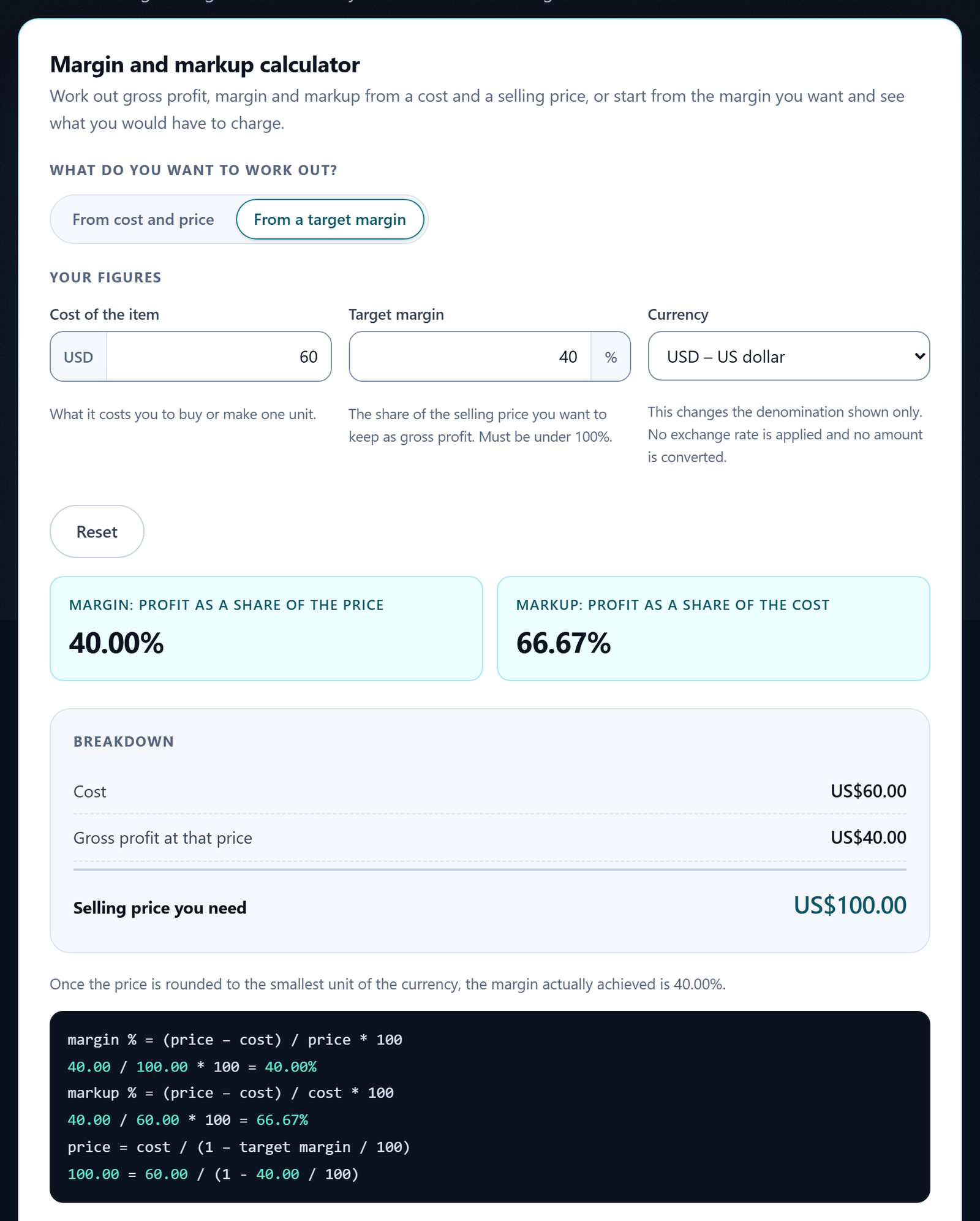
Here is the same calculation in the Margin & Markup Calculator, using From a target margin with a cost of 60 and a target of 40%. The calculator shows two decimal places, so the markup appears as 66.67%.
Converting between margin and markup
When you need to move between the two figures directly, the exact conversions are:
Markup % = Margin % / (1 - Margin %), so a 40% margin is a 66.7% markup.Margin % = Markup % / (1 + Markup %), so a 100% markup is a 50% margin.
Example
With the percentages written as decimals (40% as 0.40, 100% as 1.00):
Markup = 0.40 / (1 - 0.40) = 0.40 / 0.60 ≈ 0.667, or 66.7%
Margin = 1.00 / (1 + 1.00) = 1.00 / 2.00 = 0.500, or 50.0%
A short pricing routine
In practice, pricing toward a target margin works best as a short routine:
- Decide the gross margin percentage you need, based on overhead, tax and the profit you actually want to keep, not on what a competitor appears to charge.
- Solve for price with
Price = Cost / (1 - Target margin %), using your fully loaded cost, not just the most obvious line item. - Recalculate whenever a cost changes. Adding a flat amount on top of an old price when a supplier raises theirs keeps the markup familiar but lets the margin drift, usually downward.
- Check the resulting price against what the market will actually pay. The formula protects your margin; it does not guarantee demand at that price.
Gross margin calculated this way is before returns, payment processing fees, discounts and shipping. Those come off afterward, so a 40% gross margin is a starting point for a pricing decision, not the final profit on the sale.
Quick answers
Can margin and markup ever be the same number?
Only at zero. If price equals cost there is no profit, and both margin and markup are 0%. On any profitable sale, margin is always the smaller of the two, because markup divides by the smaller number, cost, while margin divides by the larger one, price.
Can margin be over 100%?
No. Margin cannot exceed 100%, since gross profit can never be larger than the selling price itself. Markup has no such ceiling: a low-cost item with a high price can carry a markup of several hundred percent.
Which one should I use when comparing my numbers to an industry figure?
Assume margin unless the source says otherwise. Financial statements, lending conversations and most published benchmarks report gross margin, not markup. Convert your own markup-based pricing to a margin figure with the formula above before comparing the two.
Check your own numbers
The formulas above are the whole method.
The Margin & Markup Calculator runs the same arithmetic on your own cost and price, shows the margin and the markup side by side, and solves for the price you need to hit a target margin. It all runs in the browser, with nothing sent to a server.