
A sale that looks like it earned $100 rarely puts $100 in your account. Card processors, marketplaces and payment platforms each take a cut.
These fees are usually a percentage plus a small fixed amount rather than one round number. That makes them easy to underestimate until you actually sit down and add them up against a month of sales.
Why the fee is bigger than the headline rate
Most card processors quote something like “2.9% + $0.30” per transaction. On a $100 sale that is $3.20, which sounds small.
But on a $10 sale it is $0.59 – almost 6% – because the fixed $0.30 component does not scale down with the sale price.
Businesses selling lots of low-value items typically lose a much higher percentage to fees than businesses selling fewer, higher-value items, even at the identical quoted rate.
Example
The same illustrative rate of 2.9% + $0.30, applied to two sale sizes:
| $100 sale | $10 sale | |
|---|---|---|
| Percentage part | $100 × 2.9% = $2.90 | $10 × 2.9% = $0.29 |
| Fixed part | $0.30 | $0.30 |
| Total fee | $2.90 + $0.30 = $3.20 | $0.29 + $0.30 = $0.59 |
| Fee as a share of the sale | $3.20 ÷ $100 = 3.2% | $0.59 ÷ $10 = 5.9% |
| You keep | $100 − $3.20 = $96.80 | $10 − $0.59 = $9.41 |
Over a month, $2,000 of sales made up of 20 sales at $100 costs 20 × $3.20 = $64.00 in fees. The same $2,000 made up of 200 sales at $10 costs 200 × $0.59 = $118.00.
Marketplace fees stack on top of payment fees
Selling through a marketplace or platform, rather than direct from your own site, usually means paying the marketplace’s own commission. That is commonly somewhere between 5% and 20%, depending on the platform and category.
The commission comes in addition to the underlying card processing fee. The marketplace may pass that fee through separately or bundle it into its own cut.
It is easy to budget for one of these and forget the other is also being deducted from the same sale.
Example
A $50 sale through a marketplace with an illustrative 10% commission, where card processing at 2.9% + $0.30 is passed through separately. These rates are for illustration only, not any particular platform’s.
- Commission: $50 × 10% = $5.00
- Card processing: ($50 × 2.9%) + $0.30 = $1.45 + $0.30 = $1.75
- Total deducted: $5.00 + $1.75 = $6.75, which is 13.5% of the sale
- Net payout: $50.00 − $6.75 = $43.25
Budgeting for the commission alone would lead you to expect $45.00, not $43.25.
Currency conversion is its own hidden fee
Selling to a customer paying in a different currency often triggers a conversion fee on top of the processing fee, frequently 1–3% more.
The exchange rate used is not always the mid-market rate you would see on a currency converter. Some processors mark it up further before applying their own percentage.
If a meaningful share of sales come from another country, that spread deserves a specific check with your processor rather than an assumption.
The two numbers that actually matter
When pricing a product or service, the number to plan around is not the fee percentage on its own but what it does to your target margin. Two related questions come up constantly.
“After fees, what do I actually net from this sale price?”
The fee eats directly into margin. A sale priced with no fee buffer at all can quietly under-deliver on the profit you thought you were making.
“What price do I need to charge to net a specific amount after fees?”
This is useful when a client or contract specifies exactly what you need to receive. The fee has to be added on top rather than subtracted from the price.
Example
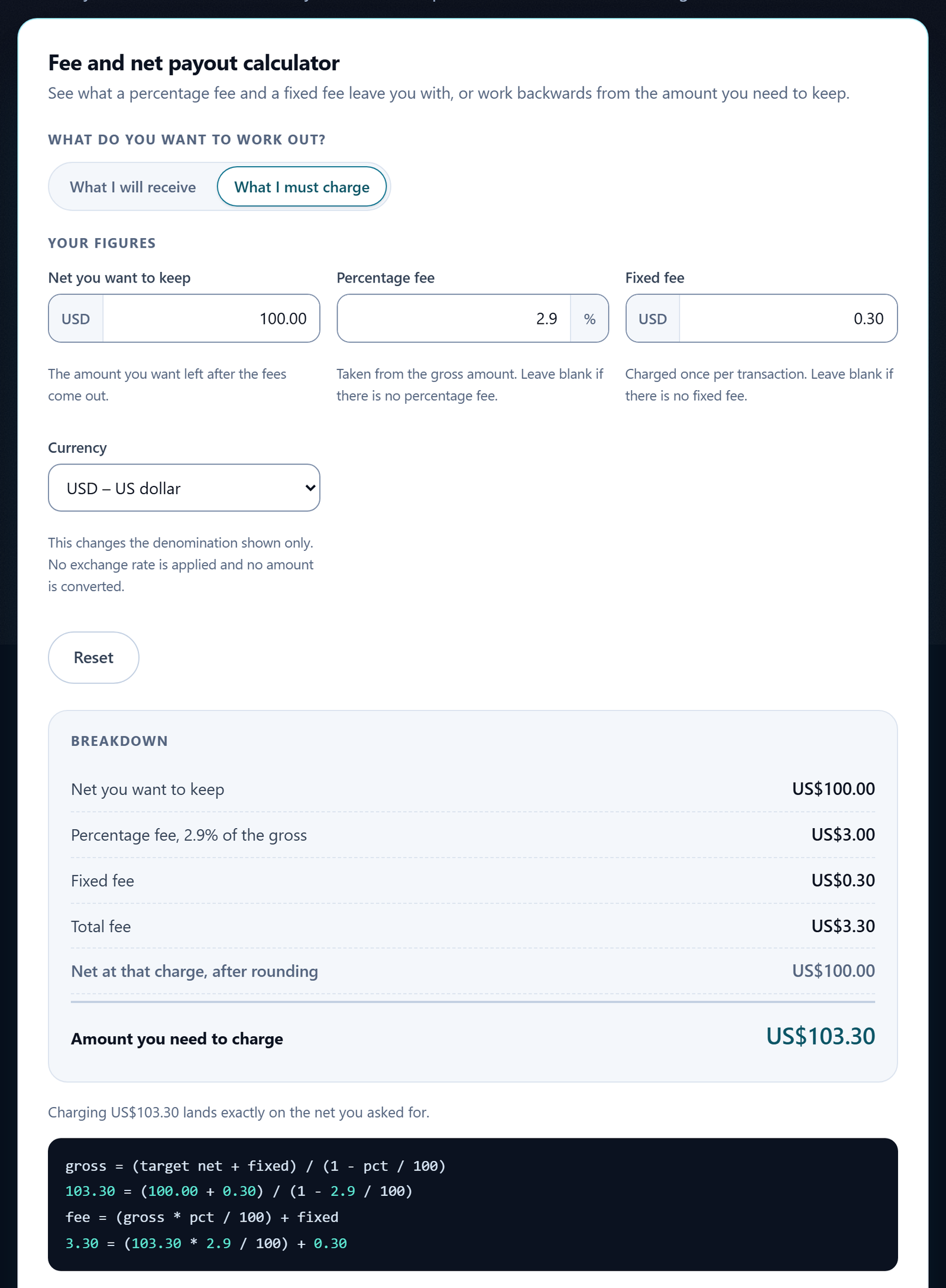
Suppose a contract says you must receive $100.00, and your rate is 2.9% + $0.30. The fee still goes on top of the $100.00, but because the percentage is taken from the higher price, working it out means dividing, not simply adding:
charge = (100.00 + 0.30) / (1 - 0.029)
       = 100.30 / 0.971
       = 103.2955...  -> rounded to 103.30

check:
percentage fee = 103.30 x 0.029 = 2.9957 -> rounded to 3.00
total fee      = 3.00 + 0.30   = 3.30
net            = 103.30 - 3.30 = 100.00
Simply adding the fee to $100 falls short: $100 + $2.90 + $0.30 = $103.20. On $103.20 the percentage part is $103.20 × 2.9% = $2.9928, rounded to $2.99, so the fee is $2.99 + $0.30 = $3.29. That leaves $103.20 − $3.29 = $99.91.
The free fee and net payout calculator linked at the end of this article does this sum in its “What I must charge” mode.
Building a fee buffer into pricing once – rather than treating every fee as an unplanned deduction after the fact – is the difference between fees being a rounding error and fees quietly compressing your margin every single month.
Watch for fee changes, not just the initial rate
Processors and marketplaces do periodically revise their fee schedules, and the change is not always announced prominently.
Reviewing your actual processor statement every few months, rather than relying on the rate you signed up under, is the only reliable way to catch a quiet increase before it has eaten into several months of margin.
Work out your real payout in seconds
The free calculator below works out the net payout after a processor or marketplace fee, or grosses up a price so a specific net amount lands in your account after fees are taken.