
Getting paid late as a freelancer or small contractor is rarely about the client being dishonest.
Far more often, it is the invoice itself – something missing, ambiguous, or easy to set aside – that gives a client’s accounts-payable process a reason to stall.
These are the mistakes that come up again and again, and the fixes are mostly one-time habits, not extra work per invoice:
- No clear due date, only “payment terms”
- Missing a purchase order or reference number
- Sending the invoice to the wrong person
- No itemised breakdown
- Inconsistent invoice numbering
- No follow-up until well past the due date
1. No clear due date, only “payment terms”
Why it delays payment
Writing “Net 30” on an invoice and assuming the client will count 30 days from the invoice date is a common source of delay.
Some accounts-payable teams count from the date the invoice was received or approved instead, especially if it sat in an inbox for a few days first.
The fix
Put an explicit calendar date – “Due 15 October 2026” – next to the payment terms, not instead of them.
A specific date is harder to quietly slide past than a countdown a client has to calculate themselves.
Example
An invoice issued on 15 September 2026 on Net 30 terms shows both lines:
Payment terms:  Net 30
Due date:       15 October 2026
15 September plus 30 days is 15 October (15 days to the end of September, then 15 more).
If the client’s team instead counted from an approval date of 22 September, the same Net 30 would land on 22 October, a week later.
2. Missing a purchase order or reference number
Why it delays payment
Many companies, even small ones, will not process an invoice through accounts payable without a PO number, project code, or the name of the specific person who approved the work.
If that number is not on the invoice, it commonly does not get rejected outright – it just sits in a queue until someone manually chases down the missing reference.
The fix
Ask for this number before you start the work, not when you send the invoice.
Example
The reference agreed before the work started, printed on the invoice:
Bill to:    Example Client
PO number:  PO-1234
Project:    Website redesign
3. Sending the invoice to the wrong person
Why it delays payment
The person who approved the project and the person who processes payment are frequently not the same person, especially once a client has more than a handful of employees.
An invoice emailed only to your day-to-day contact can wait in their inbox for a week before it occurs to them to forward it.
The fix
Ask upfront: “who should this invoice go to, and should I cc anyone in accounts payable?”
Example
Once the client has answered, the email might be addressed like this:
To:       projects@example.com   (the person the client named)
Cc:       ap@example.com         (accounts payable)
Subject:  Invoice INV-0002, PO-1234, due 15 October 2026
4. No itemised breakdown
Why it delays payment
A single line reading “Web design services – $2,400” is harder for a client to approve quickly than a breakdown showing hours or milestones and their individual rates.
If a client’s finance team has a question about one part of the total, an unitemised invoice means the whole payment stalls until that one question is answered, rather than just that one line.
What an itemised version looks like
Example
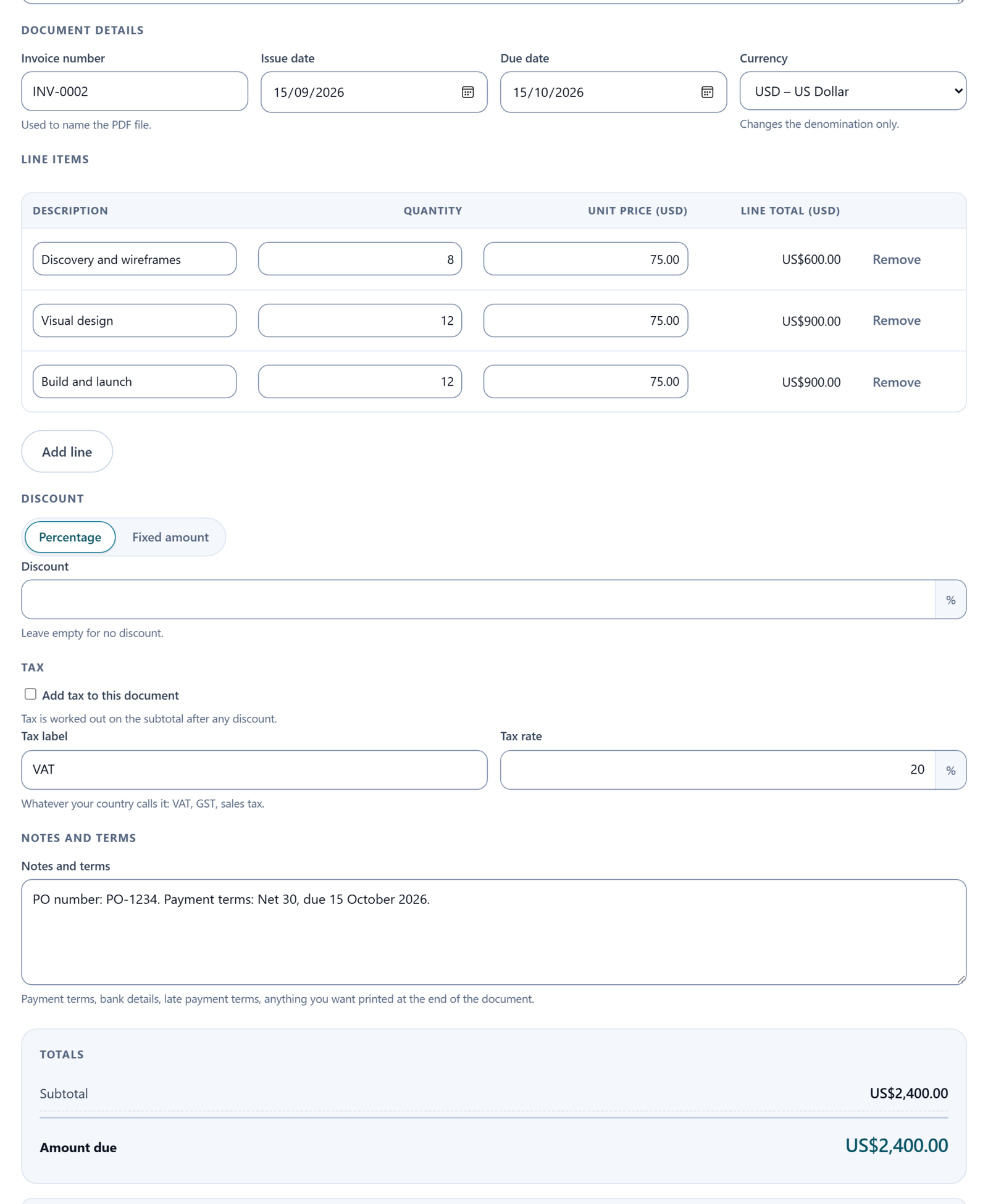
The same $2,400 split into three lines at an illustrative $75 hourly rate:
| Description | Hours | Rate | Line total |
|---|---|---|---|
| Discovery and wireframes | 8 | $75.00 | $600.00 |
| Visual design | 12 | $75.00 | $900.00 |
| Build and launch | 12 | $75.00 | $900.00 |
| Total | $2,400.00 |
Arithmetic: 8 × 75 = 600, 12 × 75 = 900, and 600 + 900 + 900 = 2,400.
The total is unchanged, but a question about the design hours now holds up one line instead of the whole invoice.
Here is that sample breakdown entered in the free invoice generator, using fictional details:
5. Inconsistent invoice numbering
Why it delays payment
Skipping numbers, reusing them, or not numbering invoices sequentially at all makes it harder for a client’s finance system to track what has and has not been paid.
It also makes it harder for you to prove what is outstanding when you follow up.
The fix
A simple sequential system (INV-0001, INV-0002) with no gaps is enough.
Example
- Easy to track: INV-0001, INV-0002, INV-0003
- Hard to track: INV-0001, INV-0004, INV-0004 (a gap after the first invoice, then a reused number)
6. No follow-up until well past the due date
Why it delays payment
Waiting a month past the due date before sending any reminder often means the invoice has genuinely been forgotten, not just deprioritised.
The fix
Send a short, polite check-in a few days after the due date passes.
It catches most delays while they are still an easy fix, rather than after they have become an awkward one.
Example
For an invoice due on 15 October 2026, a check-in a few days later might read:
Subject:  Invoice INV-0002, due 15 October 2026

Hi, just confirming this went through okay on your end.
The short version
None of this requires new software or a subscription. A consistent invoice number, an explicit due date, an itemised breakdown, and knowing the right recipient before you send it will resolve the majority of payment delays that have nothing to do with the client’s willingness to pay.
Build a clean, itemised invoice in your browser
The free Invoice & Quote Generator builds a properly itemised invoice or quote under the invoice number you choose, and exports it straight to PDF – no account or software needed.